The Art and Design of Medieval Europe
Imagine a world where you will probably never leave the location you
were born in outside of what you can actually undertake to do on foot,
where a person who had ventured beyond a radius of 100 miles was considered
well travelled; where plague and pestilence took lives by the thousands,
baths and plumbing were unheard of; where someone posessing 5 books
would be considered extremely well read, where almost the entire populace
was indeed illiterate; rats and lice ran the gamut and people were
burned at the stake as witches and warlocks. It is in this climate
that, in
often ice cold monasteries, by feeble candlelight the worlds greatest
book designers ever, crafted the finest books that mankind has ever
seen. These books were entirely handmade. The material was extremely
expensive: Parchment and natural dyes, some of which where obtained
by grinding
semi-precious stones such as Lapis Lazuli into powder and of course
gold in the shape of gold leaf. Every single letter and ornament was
painstakingly rendered and the completion
of one such book would take decades. Calligraphers
and illuminators would learn the craft
and often die before ever seeing their opus completed; one generation
would hand over the task to another. In the collophons
at the end of these books we see the names of these fine individuals
and the scrittori (by todays definition
the Art Director) who supervised them, listed.
These books were almost entirely of a religious nature, although in
the late Gothic era we do see certain secular books, such as travel
diaries and medical/herbal books. We shall look at these books starting
with the famous threesome, the 8th Century Keltic
books: The Book of Kells, The Book of Durrow
and The Lindisfarne
Gospels, and from there progress along the centuries to end our
survey in the late Gothic/early Renaisance (taking in the famous Books
of Hours and Missals on the way);
when a new spirit of enlightenment and a new technology, i.e. the incunabula
and in its wake Gutenberg and the printers' press brought this sad and
yet glorious long chapter in mankinds' story to an end:
The Keltic Threesome:
The Book of Kells

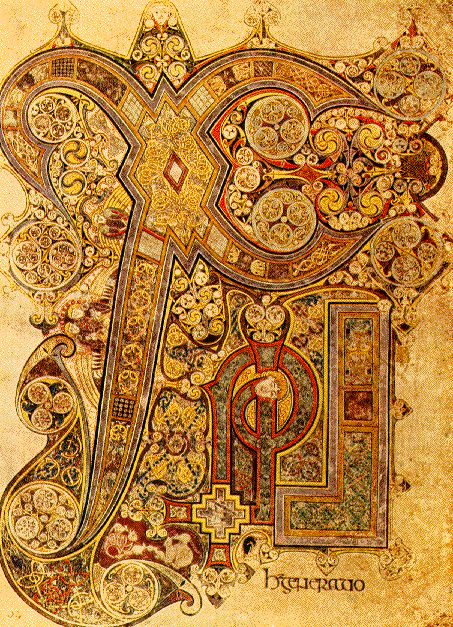
Book of Kells "Phi-Ro" Carpet Page

The Book of Durrow

The Lindisfarne Gospels
9th through 12th Centuries, Books from France,
Bohemia and England
The Gothic Type used in Medieval books is actually a solution for optimising
the usage of the expensive parchment. The compressed characteristic
of the Gothic letters enabled calligraphers to increase the amount of
text put onto each page and thus economise on material.


Diminuendo
The progressively decreasing type sizes are a hallmark
of Medieval book design:

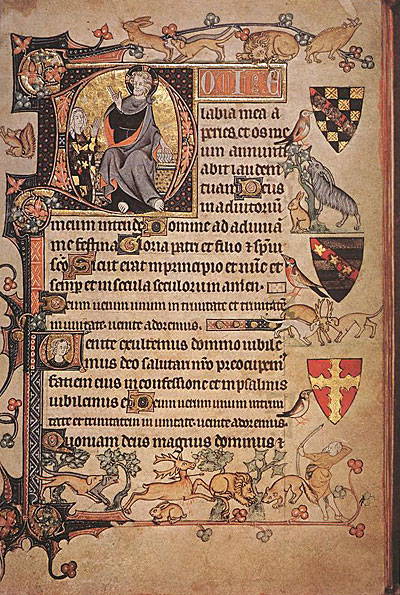
Initials
Often with wonderful illustrations:

And into the Gothic Era...
Books of Hours (devotional books that were
half prayer book and half almanacs) were especially popular with the
French aristocracy. The family of Berry especially excelled in their
patronage of book designers for generations:

Les belles Heures du Duc de Berry

The Chronicles of Hainaut

Brevarium

Codex Heroica by Philostratus

And into the Incunabula...