E-grocery
Delivery Routing Problem
The habits of
consumers shopping online have rapidly changed in the last decade as a result
of remarkable developments in e-commerce and the constant search of online
retailers for new and more profitable business models offering more flexibility
and alternative shopping experience for consumers. Many leading and visionary
online retailers look for up-and-coming business strategies to diversify their
in-stock or in-store “standard” (or “staple”) product offerings with outsourced
“premium” products, i.e. products such as organic or dietary food, specialty
gifts, specialty wine, etc., that offer higher satisfaction value to consumers
and higher profit margins to retailers.
The E-grocery
Delivery Routing Problem (EDRP) problem is motivated by a large Turkish
supermarket chain offering home delivery services to online shoppers. The
company aims at gaining competitive advantage through a new business model that
provides extended service to its customers. In this model, an online
supermarket that normally uses its brick-and-mortar stores to fulfill online
customer orders may now additionally collaborate with external vendors that
offer an extended inventory of diverse consumer items. Hence, the shopping
basket of an online customer is fulfilled either from the store or from an
external vendor, depending on the items ordered.
Within the
same context, Campbell and Savelsbergh (2005) give the more restricted
partnership model of Staples that offers office supplies and a grocery delivery
service in Canada. In a similar setting, Instacart,
an independent grocery delivery service operating in several major cities in
the U.S. (e.g. Seattle, San Francisco, Los Angeles, Austin, Maryland,
Philadelphia) allows its customers to combine items from multiple groceries in
their area (such as Whole Foods Market, Costo, Kroger, Safeway and other
retailers) into one order and have them all delivered in one order on the same
day, even within an hour. AmazonFresh offers
same-day delivery of fresh grocery and local products from bakery to ethnic
foods to gourmet meals or organic food from the neighborhood shops, restaurants
and bakeries in Northern California. In this new business paradigm, Amazon has
recently expanded its delivery network and started operating its own truck
fleet in San Francisco area (Bensinger
and Stevens, 2014, click here).
Such online shopping and delivery service is obviously not limited to the
groceries and may be extended to other retail sectors.
The EDRP is
based on a distribution network, which consists of (1) a depot, i.e. a store of
the online grocery that supplies “standard” products; (2) vendors, i.e.
external stores that supply their own set of “premium” products not available
at the depot; (3) “regular” customers, i.e. customers that only purchase
standard products; and (4) “premium” customers, i.e. customers that
additionally purchase premium products. Routing regular customers only is a
straightforward special case of the EDRP in the form of VRP (Vehicle Routing
Problem) with or without time windows. On the other hand, routing premium
customers present an additional challenge as two additional sets of decisions
are to be made simultaneously: i) allocation of vendor(s) to each premium
customer so as to satisfy the customer’s order of premium product(s); ii)
routing of regular and premium customers, and their respective vendor set while
preserving feasibility concerns such as precedence, vehicle capacity, time
windows. Under these circumstances, the delivery of goods to each premium
customer takes place only after the entire set of premium products are
collected and combined with the standard products already loaded at the depot.
Transfers between vehicles are not allowed and the minimum total distance
solution is sought in the presence of precedence, time windows, and capacity
constraints.
Emeç et al.
(2014) present the mathematical formulation of the model and develop an
Adaptive Large Neighborhood Search (ALNS) approach to solve it. They validate
the performance of the proposed ALNS using the well-known Vehicle Routing Problem
with Time Windows (VRPTW) instances of Solomon (1987) and randomly generate a
large set of EDRP instances based on Solomon’s data and report benchmark
results for future studies. The EDRP data is available here.
We present a
short case study based on a real dataset in the city of Istanbul, Turkey. We
consider two different scenarios: 1) serving customers within classic time
windows (a variant of the traditional VRPTW); and 2) serving customers within
predefined time slots (a variant of the CVRP with time length restrictions). In
both scenarios, premium products are collected from multiple vendor source
locations and then delivered to customer locations in a single basket with
standard products. The ALNS methodology proposed in Emeç et al. (2014) is
integrated with the ArcGIS 10.0 development environment to provide a convenient
user interface on a geographical information system. A cross-sectional image of
this interface is given in Figure 1. Network data, premium products list,
depots, vendors, regular customers, premium customers and vehicle capacity are
all entered as a layer or data input via this interface. The user specifies the
time window handling process, i.e. the scenario type, and selects the
visualization of the routes as straight line or true shape format. After the
problem is solved an analysis of the solution is reported. The report includes
the total route distance, route duration, number of vehicles required, vehicle
utilization, and average number of vendors visited.
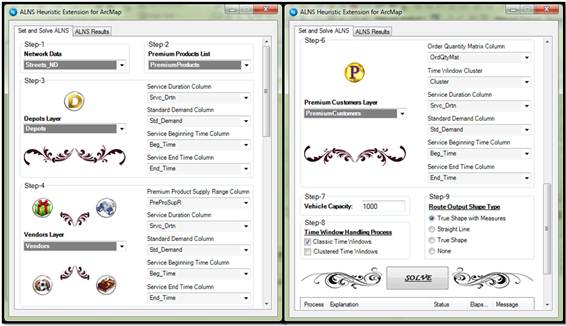
Figure 1. A
cross-sectional image of the ArcGIS-based interface
The study
area covers the surroundings of an online retailer in the Ataşehir district
located on the Asian side of Istanbul. We consider three different premium
products, namely books, souvenirs, and sports equipment. In Figure 2, the
individual suppliers of these products are represented by book, gift box, and
sports equipment symbols, respectively. We also consider “super vendors” that
supply more than one premium product at the same time. These super vendors are
represented by super market symbols. Online retailer store (depot), premium
customers and regular customers are shown with capital letter symbols D, P, and
R, respectively. We have one depot, four super vendors, thirteen individual
vendors, fifty-two regular customers, and twenty-three premium customers in
this case study.
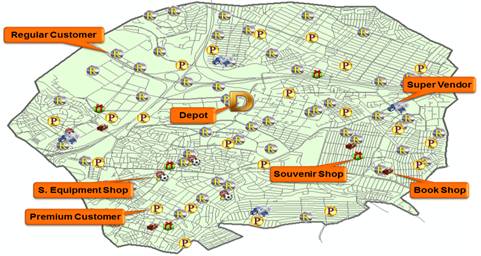
Figure 2. Problem
setting in Ataşehir, Istanbul
In the first
scenario, we solve the EDRP with traditional time windows by serving both
premium and regular customers within their individual and independent time
windows in a nine-hour time horizon. In the second scenario, we consider three
consecutive time slots, which are three hours in length. In other words, the
deliveries are grouped into specific time slots based on the time window
preferences of customers. Thus, the deliveries in the same time slot may be
treated as orders with no time windows. Compared to the first scenario, the
second one is a less flexible approach but it reduces the problem size
dramatically as a result of time-based clustering. In both scenarios, a number
of vehicles leave the store with all standard products loaded and stop by some
vendors, if necessary, on their way to visit customers sequentially to make
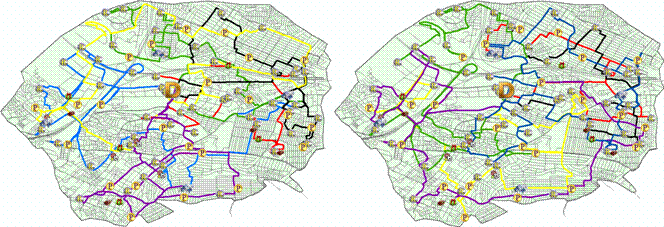
deliveries. Figure 3 illustrates the routes obtained by running the proposed
ALNS under a) Scenario 1 and b) Scenario 2 respectively.
|
(a)
Scenario 1 |
(b) Scenario 2 |
Figure 3. Routes
obtained under the two scenarios
We assume a
specific number of time slots in the analysis illustrated in Figure 6.3.
However, the number of time slots may not be foreseen in advance. In order to
investigate and evaluate the effect of time slots, we conduct a sensitivity
analysis in Table 6.1. This analysis exhibits that the required number of
vehicles and solution time shows a concave relationship with the number of time
slots. Furthermore, the total distance and total duration decrease as the
number of time slots decreases, whereas the average vehicle capacity usage
stays almost stationary with respect to the number of time slots.
Table 1. The
comparative summary of results
|
Key Factors |
Scenario 1 |
Scenario 2 |
|
Solution Time (sec.) |
250 |
125 |
|
Required # of Vehicles |
6 |
2 |
|
Total Distance (km) |
178 |
156 |
|
Total Duration (h) |
40 |
15 |
|
Average Vehicle Capacity Usage (%) |
92% |
90% |
|
|
References:
Bensinger G,
Stevens, L (2014) Amazon, in threat to UPS, tries its own deliveries. The Wall Street Journal.
(online.wsj.com/news/articles/SB10001424052702304788404579521522792859890, last
accessed on June 10, 2014)
Campbell AM,
Savelsbergh MWP (2005) Decision support for consumer direct grocery
initiatives. Transportation Science 39: 313–-327.
Emeç U, Çatay
B, Bozkaya B (2014) An Adaptive large neighborhood search for an e-grocery
delivery routing problem. Working Paper, Sabanci University.
Solomon MM
(1987) Algorithms for the vehicle routing and scheduling problems with time
window constraints. Operations Research 35:
254–265.
fresh.amazon.com,
web reference, last accessed June 10, 2014.
www.peapod.com,
web reference, last accessed on June 10, 2014.
www.instacart.com,
web reference, last accessed on June 10, 2014.